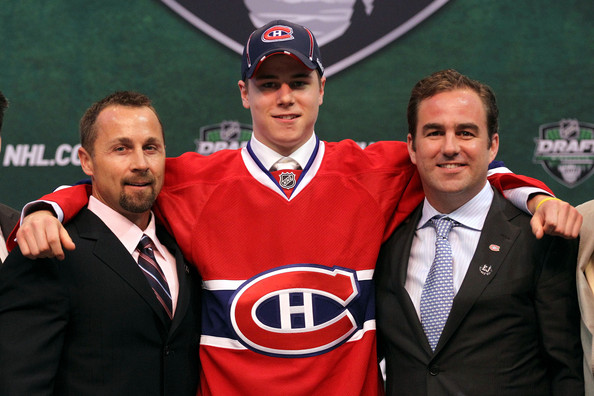
With Max Pacioretty’s six-year contract extension in the books, Marc Bergevin has continued to lock-up his young core that promises to make the Montréal Canadiens a formidable opponent in the coming years. Add to that a much-deserved extension for Trevor Timmins— Director of player procurement and development for the past 11 seasons — and the future looks bright for Bergevin’s club.
Such a holdover from the previous regime hints at a specific focus on player development, and after a draft that saw prime, young talent added to Montréal’s already improved prospect pool, Timmins’s new title as ‘Director of amateur scouting’ suggests a move towards a Pollockian era that would see old, veteran bodies shipped out for high draft picks.
It would be nice to see aging and offensively inept veterans swapped for prospects and high draft picks. Just imagine waking up tomorrow to learn of deals involving Rene Bourque, Tomas Kaberle and Scott Gomez. In Montréal, the reaction would be of utter, euphoric joy. Across the hockey world, such deals would ignite laughter and confusion, similar to the sentiments shared during the initial transactions.
Yet unfortunately for Habs fans, the modern NHL — the salary cap world — deters financially stable teams from shipping off prized draft picks for temporary band-aids. Though these types of deals spontaneously occur — Bob Gainey, Scott Gomez, Ryan McDonagh — to really appreciate a good ol’ fashioned fleecing, look no further than the legendary Sam Pollock.
It’s no secret to any knowledgeable Canadiens fan, that when forced to choose the best GM in Montréal’s storied history, Pollock’s name immediately comes to mind.
And with a second NHL lockout in the past ten years looming, sometimes it’s best to look back to a dynasty instead of forwards to an inevitable lockout.
The year, 1970, the primary focus, the 1971 NHL Entry Draft. In a 12-team league, it was relatively easy to separate the bottom feeders from the cream, and during the 1970-71 regular season, Pollock looked towards Oakland and planned for the future.
Why? In the late 60s and early 70s, a teenager from Thurso, Québec was making noise for the Québec Remparts. Amassing 170 points in his final season in Québec, Guy Lafleur was a young prospect that seemed destined to dominate the NHL for a decade, and with it all but inevitable for the woeful Los Angeles Kings to finish in the cellar, Pollock schemed and manoeuvred his way into the first-overall selection in the 1971 NHL Entry Draft.
The draft, and more so the events that led up to it, helped paint Pollock as one of the greatest and most creative General Managers in NHL history. Here’s the short-form of how the Canadiens wound up with Hall-of-Famer and NHL legend, Guy Lafleur.
Prior to Lafleur’s draft year, Pollock managed to convince the California Golden Seals to swap their first-round pick and Francois Lacombe for Montréal’s and Ernie Hicke. With the Seals finishing fourth in their division and ahead of the Kings a season earlier, the trade bettered Pollock’s chances in drafting Lafleur. But Pollock didn’t stop there.
With the 1970-71 season in full swing, much to the chagrin of Pollock, the Kings were beating out the Seals for the basement title, a battle that would force Montréal’s GM to craft another trade that would help Los Angeles ascend the standings and leave the Canadiens with the No. 1 overall selection, and more importantly, the chance to draft Lafleur.
As a result, on January 26, 1971, Pollock sent scoring centre Ralph Backstrom to the Kings for Gord Labossiere and Ray Fortin for the sole purpose of improving the Kings roster and thus helping them overtake the Seals in the standings and ensure the number one overall pick for Pollock’s Canadiens.
Pollock ended up with the first selection and despite an initial sense of hesitancy — Marcel Dionne was also eligible to be taken in the 1971 NHL Entry Draft — he chose Lafleur with the Seals’ pick.
In the modern-day NHL, such a trade, especially for a high-end draft pick with franchise potential, is nearly impossible to come by. In comparison to Pollock’s Lafleur deal, imagine hearing of a lowly team like Columbus, with — hypothetically speaking — the first overall selection in the 2013 NHL Draft and the opportunity to select either Nathan Mackinnon or Seth Jones, trades it away for a fringe NHL forward and a middle-of-the-pack first round draft pick.
Such a transaction would cripple a franchise’s fan base.
In terms of economics, and in the salary cap era, small-market and even big-market teams depend on cheap, high-end production. There isn’t any better opportunity to acquire that type of player than through the draft. And when it comes to drafting players, as Canadiens fans have become well aware of recently, the ability to properly develop them becomes a monumental task for any management team.
Fortunately, when Bergevin put his finishing touches on the Habs’ front office, adding names like Martin Lapointe — director of player development — and a familiar face in Patrice Briseboi s—player development coach — he placed a special focus on progress and growth in Montréal’s budding prospect pool that will hopefully speed up the development process and help them better understand the physical and mental demands of the NHL.
---
Derek is a Queen’s University student, contributing writer for OTwinner, HabsAddict.com, and freelance journalist for print magazine SportsXpress. His passion for the Canadiens was solidified on April 9, 2002, when Saku Koivu returned from Burkitt’s lymphoma and became an emblem of perseverance and strength.
Follow Derek on Twitter
(Photo by Bruce Bennett/Getty Images North America)
Such a holdover from the previous regime hints at a specific focus on player development, and after a draft that saw prime, young talent added to Montréal’s already improved prospect pool, Timmins’s new title as ‘Director of amateur scouting’ suggests a move towards a Pollockian era that would see old, veteran bodies shipped out for high draft picks.
It would be nice to see aging and offensively inept veterans swapped for prospects and high draft picks. Just imagine waking up tomorrow to learn of deals involving Rene Bourque, Tomas Kaberle and Scott Gomez. In Montréal, the reaction would be of utter, euphoric joy. Across the hockey world, such deals would ignite laughter and confusion, similar to the sentiments shared during the initial transactions.
Yet unfortunately for Habs fans, the modern NHL — the salary cap world — deters financially stable teams from shipping off prized draft picks for temporary band-aids. Though these types of deals spontaneously occur — Bob Gainey, Scott Gomez, Ryan McDonagh — to really appreciate a good ol’ fashioned fleecing, look no further than the legendary Sam Pollock.
It’s no secret to any knowledgeable Canadiens fan, that when forced to choose the best GM in Montréal’s storied history, Pollock’s name immediately comes to mind.
And with a second NHL lockout in the past ten years looming, sometimes it’s best to look back to a dynasty instead of forwards to an inevitable lockout.
The year, 1970, the primary focus, the 1971 NHL Entry Draft. In a 12-team league, it was relatively easy to separate the bottom feeders from the cream, and during the 1970-71 regular season, Pollock looked towards Oakland and planned for the future.
Why? In the late 60s and early 70s, a teenager from Thurso, Québec was making noise for the Québec Remparts. Amassing 170 points in his final season in Québec, Guy Lafleur was a young prospect that seemed destined to dominate the NHL for a decade, and with it all but inevitable for the woeful Los Angeles Kings to finish in the cellar, Pollock schemed and manoeuvred his way into the first-overall selection in the 1971 NHL Entry Draft.
The draft, and more so the events that led up to it, helped paint Pollock as one of the greatest and most creative General Managers in NHL history. Here’s the short-form of how the Canadiens wound up with Hall-of-Famer and NHL legend, Guy Lafleur.
Prior to Lafleur’s draft year, Pollock managed to convince the California Golden Seals to swap their first-round pick and Francois Lacombe for Montréal’s and Ernie Hicke. With the Seals finishing fourth in their division and ahead of the Kings a season earlier, the trade bettered Pollock’s chances in drafting Lafleur. But Pollock didn’t stop there.
With the 1970-71 season in full swing, much to the chagrin of Pollock, the Kings were beating out the Seals for the basement title, a battle that would force Montréal’s GM to craft another trade that would help Los Angeles ascend the standings and leave the Canadiens with the No. 1 overall selection, and more importantly, the chance to draft Lafleur.
As a result, on January 26, 1971, Pollock sent scoring centre Ralph Backstrom to the Kings for Gord Labossiere and Ray Fortin for the sole purpose of improving the Kings roster and thus helping them overtake the Seals in the standings and ensure the number one overall pick for Pollock’s Canadiens.
Pollock ended up with the first selection and despite an initial sense of hesitancy — Marcel Dionne was also eligible to be taken in the 1971 NHL Entry Draft — he chose Lafleur with the Seals’ pick.
In the modern-day NHL, such a trade, especially for a high-end draft pick with franchise potential, is nearly impossible to come by. In comparison to Pollock’s Lafleur deal, imagine hearing of a lowly team like Columbus, with — hypothetically speaking — the first overall selection in the 2013 NHL Draft and the opportunity to select either Nathan Mackinnon or Seth Jones, trades it away for a fringe NHL forward and a middle-of-the-pack first round draft pick.
Such a transaction would cripple a franchise’s fan base.
In terms of economics, and in the salary cap era, small-market and even big-market teams depend on cheap, high-end production. There isn’t any better opportunity to acquire that type of player than through the draft. And when it comes to drafting players, as Canadiens fans have become well aware of recently, the ability to properly develop them becomes a monumental task for any management team.
Fortunately, when Bergevin put his finishing touches on the Habs’ front office, adding names like Martin Lapointe — director of player development — and a familiar face in Patrice Briseboi s—player development coach — he placed a special focus on progress and growth in Montréal’s budding prospect pool that will hopefully speed up the development process and help them better understand the physical and mental demands of the NHL.
---
Derek is a Queen’s University student, contributing writer for OTwinner, HabsAddict.com, and freelance journalist for print magazine SportsXpress. His passion for the Canadiens was solidified on April 9, 2002, when Saku Koivu returned from Burkitt’s lymphoma and became an emblem of perseverance and strength.
Follow Derek on Twitter
(Photo by Bruce Bennett/Getty Images North America)
