Showing posts with label goaltending. Show all posts

Sunday, October 26, 2014

Eight thoughts after eight games

Hey Habs fans. It's been a while since I lasted posted here and I have a few thoughts on the Habs and NHL I wish to share with you. Please feel free to weigh in and comment.

The Schedule. The schedule makers did Montreal no early favors starting them off with a tough four games in six night road trip. Then, immediately after the first home-stand which ended last night vs. the NY Rangers, the Canadiens pack their bags and head out on a Western Canada road trip through Alberta and BC. In fact, the Habs play virtually either every night or every other night right through December 5th. The following week they play just twice. It will be interesting to see how the fatigue factor comes into effect with so much hockey to be played the next six weeks or so.

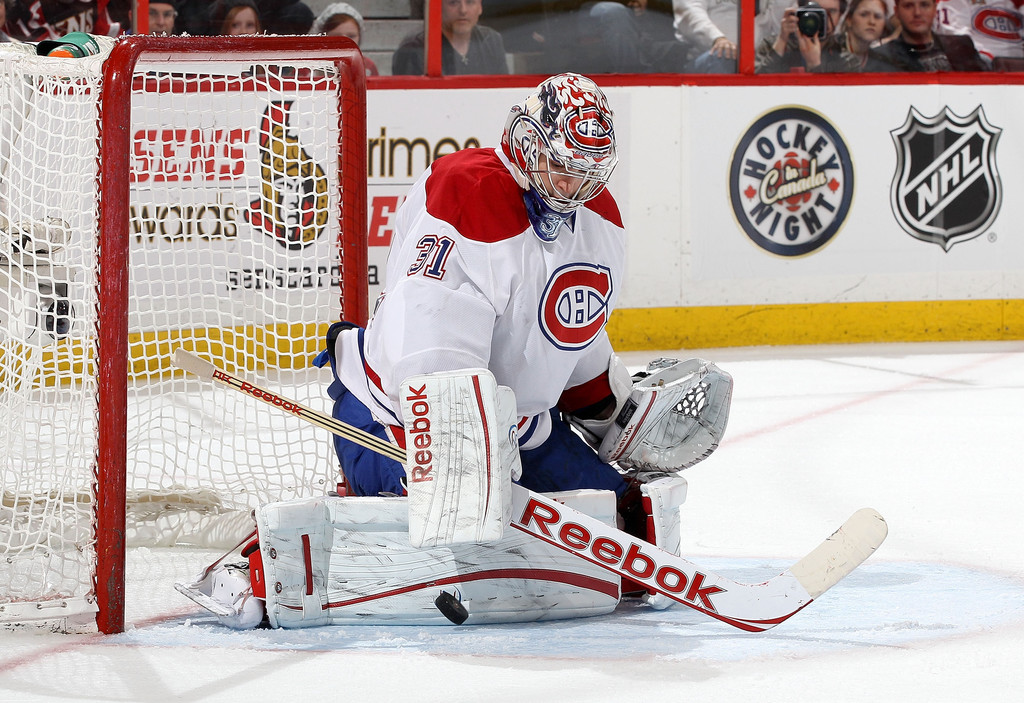
Goaltending Just prior to the start of the regular season on October 5th, GM Marc Bergevin traded veteran goaltender Peter Budaj to the Winnipeg Jets for forward Eric Tangradi. The move effectively made rookie Dustin Tokarski the new backup to starter Carey Price. There was some concern heading into the season about the health of Price, whose playoff run ended early on this dirty play by Rangers pest Chris Krieder. Price has proven that he is back and better than ever. Through his first seven starts, he has allowed 18 goals on 190 shots for a .913 save %and a 2.67 goals against average. Those numbers are improving every game and are bound to improve as the season progresses. Meanwhile, Tokarski has made two appearances, starting in Washington and performing mop-up duty in TB. I'm not worried about the goaltending. This tandem of Price and Tokarski will give the Habs a chance to win on most nights.

Canada's Team? Although it is a brief sample, after eight games, Montreal looks like Canada's best hope to win a Stanley Cup. Toronto has its usual goaltending problems, Ottawa is also off to a good start, but they are a young team and will not be able to sustain the effort all season. In the west, the Canucks have a older team and are atrocious in the faceoff circle. Winnipeg's Evander Kane has demanded a trade and anytime you have an unhappy player in the locker room it creates division. Also, the team still very much resembles the one it inherited when Atlanta relocated to Winnipeg three seasons ago. Edmonton has a comical way of defending and Calgary is very much in a rebuilding stage, likely in the running for Connor McDavid. Montreal currently has a great mix of players who are just entering their prime at the same time, from defenseman PK Subban to Price. The Habs resemble the 2011 Vancouver Canucks squad who dominated the league and nearly brought the Stanley Cup back to Canada.

The Refereeing. So far, the refereeing hasn't been stellar. Case in point, opening night Toronto scored a goal that should have been blown dead due to an obvious offside. The following night vs. Washington, the Habs had two goals called back in the 3rd period. This season, the referees are conferencing on controversial calls. I'm still an advocate for increased video review, especially on goals that should or should not be counted. I think penalty calls should continue to be discretionary with the exception of too many men on the ice calls. That penalty is not called often enough in my opinion. I also think coaches challenges are worth trying in the AHL or junior league or a preseason game next year.

Shootouts. The shootout has been a controversial addition to NHL games. Introduced after the 2003-04 lockout in an effort to make sure there are no ties in hockey, many games that have gone beyond 60 minutes have been decided in the shootout. There are many fans who argue that the shootout is not a fair way to decide a game. There are some teams that just aren't good at a shootout. The Vancouver Canucks have been traditionally bad at it. Also, you might have a game where one side plays awful but manages to get to a shootout and because they are good at the skill game they win. In an effort to cut down on the number of games decided by the shootout, the NHL implemented a few changes. First, at the end of regulation there is a dry scrape of the ice. Second teams switch ends, thus making line changes harder when tired. Finally, the spin-o-rama has been eliminated as a legal move in the shootout. Have the changes worked? Of the 27 games that have gone beyond regulation time, 15 of them have required a shootout. I think the switching of sides is a good idea but perhaps the dry scrape has the opposite effect. By dry scraping the ice, the puck sticks  to the surface. Teams need more incentive to win in regulation or OT. I propose that teams get three points for winning in regaulation, two for overtime and just a single point for winning in a shootout. The losing team gets nothing at all.

Expansion/Relocation. There has been much debate of expanding the league by a couple of teams. Las Vegas, Seattle and Quebec City. Before considering expansion, one has to ask whether there is enough viable NHL talent that an expansion team would win consistently? Currently the Carolina Hurricanes are winless and there are several teams that have won just twice in their 7 or 8 games. There is an imbalance of talent between conferences with the West generally dominating and the Eastern conference having a few teams doing well, including your Habs. If the NHL wants to go the relocation route, Florida would be a prime candidate to move. Their attendance has been abysmal the last few seasons, especially this one. Part of the problem is the Panthers aren't winning despite having to spend tons of money on high-end talent just to make the cap floor. Also, the Panthers are having to compete with the MLB (Miami Marlins), NFL (Miami Dolphins), college football, and NBA (Miami Heat). In my opinion, the league should not consider expansion but should definitely consider relocating teams like Florida and Carolina. I highly doubt the league would simply fold a team like Florida due to loss of revenue. Instead, I can see the league relocating to a more viable location.

Ottawa Tragedy I would like to give a shoutout to the fallen Corporal Nathan Cirillo, who was gunned down Wednesday in a terrorist attack that could have ended so much worse if not for the quick action of Sergeant-at-Arms Kevin Vickers who killed the lone gunman. Like many of you I was moved by the actions of bystanders who tried in vain to save the fallen Cirillo. Kudos to every NHL team who played the Canadian anthem and honored our fallen soldier, I wish MLB had followed suit instead of simply releasing a statement on behalf of the Toronto Blue Jays. I do not wish to turn this blog into a political debate. However, we must not condone the actions of extremists. In times like this week, we are not Habs fans, we are Canadian citizens who stand together as one united voice that terrorists will not win. Please hug your loved ones tonight and keep in your thoughts and prayers those currently fighting overseas and/or enrolled in the military. #OttawaStrong.

Playoff Rematch. Montreal faced Tampa Bay, Boston and NY Rangers respectively in their lengthy playoff run last season. Already they have had one game against each this season. One has to wonder if the Habs would have beaten Tampa Bay if a healthy Steven Stamakos was available. When the Habs faced the Lightning, Stamakos had only recently returned from a bad break in his leg on this play. Based on the start he has had this season, if he was healthy last season, the Habs would have had a tougher fight on their hands at the very least. The Habs defeated the Bruins in an entertaining battle that featured 10 goals. Finally tonight, they exacted their revenge in a clinical 3-1 victory over the Rangers. Not surprisingly, Chris Kreider was booed mercifully after he took out Carey Price in last year's playoffs. All in all, it's great to see the start Montreal has had to their season

Go Habs Go

Friday, April 26, 2013

Carey Price and A Weak Penalty Kill Are Sinking the Montreal Canadiens


Carey Price has lost his confidence (Credit: Eric Bolte-USA TODAY Sports)Another game, another loss for the Canadiens last night against the New Jersey Devils. This time, the Habs managed to stay in the game after trailing 3-0 early on to finally capitulate 3-2, losing their fifth game in six contests. Montreal surrendered two more goals in four attempts on the penalty kill, ultimately sinking the team once again. Luckily for the club, the Boston Bruins lost 5-2 to the Philadelphia Flyers, so both teams remain at 59 points.
In fact, the team’s short-handed unit has been abysmal during the recent slump, killing only 15 of their last 25 penalties for a mediocre efficiency rate of 60% since they clinched a playoff berth on April 11th, 2013 in Buffalo. The Canadiens are now ranked 25th in the NHL with a putrid 79.35% efficiency rate, a far cry from last year’s excellent penalty kill rate of 88.6%, that was good for 2nd in the league.
Another problem is that the Canadiens are very undisciplined this season, having to kill 164 penalties in 46 games this season. They rank 6th in that area in the league, the five other most undisciplined teams all being out of the playoffs (PHI, BUF, DAL, EDM, COL) at the moment. Overall, the Habs have allowed an astounding 34 goals with a man short, which ranks them 27th in the NHL. Overall, the Boston Bruins and the Chicago Blackhawks have allowed the fewest goals (18) with a man down this season, or almost half as the Canadiens.
What is even more strange is that the team fares better on the road with a man short, killing penalties at a good efficiency rate of 81.3% (good for 11th) away from Montreal, while posting a dreadful 77.5% efficiency rate (good for 27th) on home ice.
To illustrate the team’s penalty kill woes, Carey Price has a great 2.05 goals against average (GAA)/60 minutes at even strength compared to an abysmal 8.87 GAA/60 minutes with a man short. In comparison, Peter Budaj has a 3.87 GAA with a man short to go along with a 2.35 GAA/60 minutes at even strength. This statistic would explain Price’s inflated GAA of 2.60 this season, good for 28th among qualified goaltenders in the NHL.
Josh Gorges is clearly exhausted which hurts the penalty kill (Icon SMI)
As for save percentage, the Price is still wrong as the Habs’ number one netminder is 36th among qualified goaltenders with a putrid .904 save percentage (to Budaj’s .906 save %). The problem is that Carey Price is worst in the entire NHL among qualified goalies with an abysmal save percentage of .803% with a man down. In fact, only Ryan Miller has allowed more goals on the penalty kill (31) than Carey Price (30).
Is it because the whole defensive unit is a mess or simply because Price is unable to make the key saves when the team needs him most?
The fact that the Canadiens have yet to score a single goal on the penalty kill doesn’t help them to create scoring chances and killing precious time. Instead, the forwards always dump the puck deep in the opponent’s zone instead of taking more chances and take advantage of odd-man rushes. Michel Therrien also needs to adjust his defensive strategy and use different players on the penalty kills.
Why play grinders like Travis Moen, Colby Armstrong, Brandon Prust and Jeff Halpern when they don’t get the job done? Why not use faster players that are an offensive treat such as Lars Eller, Rene Bourque, Max Pacioretty and Alex Galchenyuk? These offensively-gifted players would keep the other team’s defensemen on their heels and would create turnovers rather than allow them to play with great confidence.
As for defensemen, Andrei Markov and Josh Gorges are clearly exhausted from playing too many minutes, so why not cut their ice-time at even strength in order to allow them to be more efficient on the penalty kill? Once again, Markov was the most used rearguard last night, playing 23:34 minutes despite showing clear signs of fatigue in the past ten games, posting a -10 plus/minus rating while recording a mere 2 goals and 1 assist for 3 points.
With only two games remaining to the shortened NHL season, why not use seven defensemen to spread out the minutes better and rest Markov and Gorges, while playing more the Habs’ first three lines instead of playing the fourth line 12 minutes a game? Young defenseman Jarred Tinordi has joined the team in Winnipeg in prevision for tomorrow’s match-up with the Jets, so why not dress him as a seventh defenseman? This would give the Habs some much-needed toughness on the back end, allow Michel Therrien to rest his key elements on the blue line and ease Raphael Diaz’ return to the line-up even more after a long-term injury.
To be successful in the playoffs, the Canadiens will need to take the lead early as they have yet to win a game when trailing after the first period this season (0-7-1). The Canadiens will also have to play a good defensive game in order to win as the Bleu Blanc Rouge has only three regulation wins when the opposition scores 3 or more goals! Finally, Montreal will need to be disciplined! If they can avoid taking lazy and dumb penalties, they will have success and go deep in the playoffs.
Now, let’s start the game on time Thursday against a desperate Jets team, otherwise we might as well be playing for the home-ice advantage against the Toronto Maple Leafs on Saturday.

Saturday, January 5, 2013

Game Winning Goal Vs. Russia A Microcosm For Canadian Shortcoming?

Welcome to the Weekend, PuckAddicts!!!

Having watched the entire World Junior Hockey Championship, as well as the preparatory games played by Team Canada, one can't help but wonder if there are issues with Hockey Canada's structure.

The game winning goal versus the Russians brought forth a bunch of issues that can't be ignored. Moving forward, Hockey Canada and its brain trust have to take an objective look at their development model, but the problem stem far beyond the Program Of Excellence.

The Selection Process

For the past five tournaments, there have been questions as far as who is selected to represent Canada in major international tournaments. Does Hockey Canada have an identity for their teams? Recent history would suggest that they don't.

Over the years, the scouting department at Hockey Canada has been tasked with selecting the pool of talent invited to their respective selection camps. However, the selection of players is given primarily to the coaching staff appointed to each team. On most occasions, the coaches are influenced by players they are familiar with, expecting their task of preparing their teams in a short period of time to be lessened by their selections.

Coaches tasked with the privilege of coaching their country's team need to realize that their own players have established chemistry with the other players on their respective club teams. Furthermore, playing together for an extended period of time makes performing on the ice easier, since their is a familiarity between teammates.

The Program of Excellence opens the door to ALL Canadian players. There are a plethora of players, who may be unfamiliar to the coaches, whose skill sets are better suited for international play. It's time for Hockey Canada to take a more proactive role in the selection process. While coaches can still make recommendations on who they may want on their rosters, it remains Hockey Canada's job to select the best players that fit the mold of the type of team they want to put forth.

Goaltending

Canada's inability to produce top quality goaltenders has become a real issue on the international stage in the past few years. While a goaltender's stats alone can be impressive, their technical game is more important in a tournament of the WJC's magnitude.

If we examine the technical aspects of Malcolm Subban's game, for example, there are many reasons why he looked weaker than he actually is.

Let's give him his dues. As a goaltender, his reflexes are incredibly quick and he plays his angles very well. The fact that Belleville plays on a large ice surface help him at the international level from that respect. However, his flexibility and lateral movement, as was exploited in the game winning goal, were weaker than some of his predecessors.

Subban's butterfly was weakened by the lack of flexibility in his knees, and his inability to do a full split. On many occasions, his pads would be down, but the knees would be slightly off the ice, leaving a sizable gap in the area of the five-hole. Also, as seen in overtime, he often slides post to post on his rear-end, as opposed to on his pads, in order to cover as much area down low as possible. Those shortcomings have been apparent since the onset of this year's tournament, and were exploited by the opposition.

A general issue among all Canadian goaltenders is also their willingness to go down quickly when facing a shot. Most goaltending "gurus" use percentages to teach their trade, taking a goalie's athleticism out of the equation altogether. While the butterfly was a surefire way to tend goal in its infancy, adaption dictates that a change in the development model for goalies is required. Some of the more successful goaltenders in the CHL and European junior leagues have already employed a more hybrid approach.

And that's just the beginning. While there are many others issues that Hockey Canada needs to address, including a lack of versatility from their defensemen, correcting these two major issues would go long way to reestablishing Canada's credibility as a hockey power.


Monday, August 27, 2012

Montreal Canadiens Uniform, Old Rules, Brandon Prust and More

Happy Monday Hab fans!

A few days ago, ESPN's Uni Watch released its ranking of uniforms for the four major North American sports. 

Who had the best jersey? 

The Montreal Canadiens, of course. 

Conversely, the NBA's Sacramento Kings were deemed as having the worst. As for the NHL, the Colorado Avalanche's set is considered the least appealing.

As for Canadian teams, the Edmonton Oilers were ranked 104th out of 121. Not exactly stellar. Personally, I wish they would bring back this logo. 

What do you think? Which NHL teams have the prettiest and ugliest uni's? 

Hockey and Habs news

- Our Amos Legault takes an insightful and humorous look at some of the NHL's old rules for goaltenders. Honestly, some of the rules seem pretty silly under today's standards.

- Hockey Inside/Out looks at how Brandon Prust will be missed by his former New York Rangers teammates. 

- HabsWorld's Fantasy Focus continues with looks at both Andrei Markov and Josh Gorges. 

- CBA talks will resume this Tuesday and the NHL will reportedly be tabling a new offer. Meanwhile, Adrian Dater of Sports Illustrated dissects the similarities between the 2004-05 negotiations and the current ones. 

Sunday, August 26, 2012

Revisiting The NHL Rules Of Old: Goaltending

Beginning this Tuesday, the NHL will be digging through some video of hooking, holding and interference penalties that were administered last season.

The goal for Colin Campbell — Director of Hockey Operations — as well as some select general managers and coaches is to try and determine a standard on the implementation of interference penalties.

As the "think tank"— as Campbell calls it —gets set to tighten up ship, I thought I'd take a brief trip back to some interesting rules of old.

In considering our penalties and the tweaking of them, would we do well to take a page from the history books?

Goaltending

In regards to netminding, the very first change to the original rules was in the 1917-18 season. Originally, a penalty would be called on the goalie for dropping to the ice to make a save at any time. It wasn't until that season that they were permitted to do so.

Could you imagine? Carey Price would be giving Steve Ott a serious run for his money in the PIMs department.

Concern of a decrease in action and goal scoring goes as far back as the early twenties. One of the first examples of this was in 1921, where goalies were finally allowed to pass the puck up to a player, but only as far as his own blueline.

This may or may not have coincided with defense becoming the lazy man's first choice of position in beer leagues.

A more direct approach came with the first limit set for a goalie's pad width. Starting in the 1925-26 season, twelve inches was as thick as you could have them, and it was further reduced to ten inches in 1927.

The nineteen-thirties saw some familiar first incarnations of rules we see today, including penalties for doing the Sean Avery and obstructing a goalie's vision or movement.

What's more interesting though are the strange ones, which included things like the goaltender cannot advance more than one foot from his goal-line when a shot is taken (1934-35) or each team must have only one goaltender playing at one time (1931-32).

And rightly so! Imagine two Dominik Haseks flopping all over the place? It'd be absolute mayhem.

That's using the old noodle, fellas. The NHL: always a step ahead of everyone's tricks.

As for the 'one foot from the goal-line' rule, I'd like to imagine that goalkeepers were doing all kinds of outrageous things to stop attackers from even getting shots off in the first place.

Though I suspect it was mostly frequent rushing and challenging of the shooter that lead to the rule.

More chances, more breakaways, more shots, more goals, more fans, more money.

Perhaps the most interesting item I came across in regards to goalies was that they used to serve their own penalties. So, if Price delays the game, Peter Budaj gets thrown in nets for a penalty kill— this of course being when teams were eventually required to dress two goalies, which wasn't always the case.

How interesting would that make games, especially in the playoffs ?

As goalies were penalized a lot more often then, the back-up would see more action, and on a game-by-game basis.

Oh, but there's one tiny catch...

As a rule implemented in 1939 states, if you were the back-up, you were only allowed to use a goaltender's gloves and a stick. That's it.

Food for thought!

Next up, the Attackers and Rearguards portion of our trip back in time.
---
Amos is freelance writer and columnist who covers prospects for HabsAddict.com. You can follow him on Twitter and Facebook or email him at alegault@gmail.com

(Photo by Jana Chytilova/Freestyle Photo/Getty Images North America)