Showing posts with label penalty. Show all posts

Tuesday, September 25, 2012

Revisiting the NHL Rules of Old: Forwards, Defensemen and More

Good afternoon puck addicts.

I think it's safe to say at this point that we're all tired of discussing players who are wearing suits in lieu of jerseys.

Researching the history hockey when the game in its current state comes with a few sad feelings of longing for something you've never experienced.

But as a fan, what can you do but think progressively?

That being said, feel free to let this retrospective on NHL rules rules of old remind or inform you of a time when the game was a game.

After part one focusing on goaltenders, we will look at how old regulations impacted forwards, defensemen and other aspects of the game.

Rest assured, this article will not contain the words 'owner', 'billion' or 'million'.

Attackers and Rearguards

In the midst of player salary negotiations, it's worth noting that in the very young stages of pro hockey, the National Hockey Association — the precursor to the NHL — had a seventh position on the ice.

It was a fourth forward called the 'rover', which was positionally the shortstop of hockey; behind and to the side of the centerman. It was in 1911 that the league adopted the more symmetrical six-man game that we see today.

The reason for the change? The league likely cited a want for more punch and less wrestle. Two fewer men equals more movement in the game.

After all, it was just one year prior to this that they implemented the change from one intermission to two. Two periods at half an hour each was a game that surely saw more fatigue and less action.

In fact, during my research it seemed to be that nearly every rule change since the turn of the century was a direct attempt to increase offense and action. The league's ideas were working and by the mid-twenties goalscoring more than doubled and was climbing still.

Some Just Don't Work

A rule is thought of, approved and implemented by more than just one fool with a hunch, and there's usually a coherent reason for its implementation.

However, this has not always been the case.

For a comically long time — until the 1927-28 season — an attacker with the puck, in any zone but the offensive one, couldn't make a forward pass. He was to bring the puck into the offensive zone himself before passing and beginning a play.

Incidentally, it was in the same year that they started assessing a penalty to a player who picks up the puck and carries it.

Far more perplexing was an extension of the rule that awarded a penalty shot for being tripped and thus prevented a clear shot on goal. You got the shot alright, but it had to be taken from within a ten foot circle, located almost 40 feet from the net.

Makes sense, right? Don't worry, the silliness was adequately evened out. The netminders weren't allowed to advance more than one foot from the goal-line during the shot.

How long did it last? The rule was implemented in the 1934-35 season and lasted until 1941, where the player was permitted to skate in for the shot. It clearly couldn't last, but that's still six solid seasons of awkward shots that likely never went in.

Some Could Still Work

After many decades since its first application, the rule against kicking the puck into the net is still largely debatable.

Prior to the 1929-30 season you could kick, punch, slap, or headbutt that puck into the net, so long as it went in. You put the puck in the net; you score.

I personally subscribe to the idea of allowing the puck to be kicked in, as long as it's on the ice. As Brian Burke would agree, we are very much in the butterfly era of goaltending. I can't see any disadvantages from their perspective. Once the puck reaches the slot and the crease, today's netminders are constantly tracking the puck down low.

Is there really a difference? Where do you guys stand on this?

Another one that I liked, which is more of a fun aspect of the game rather than a rule, was in the late twenties where the home team would start the game by choosing which goal to defend.

This was in a time where the ice was certainly more crude, more likened to a back-yard rink, which is something that would've impacted one's choice in sides more than it would today.

Teams today are a lot more serious about their advantages and disadvantages, as there's truly more at stake than there used to be, so this is something that would only create problems.

Up Jumped the Devil

I'll leave you with a few fun facts that in some ways marked the beginning of true consumer-based hockey, and is fitting with the league's current state.

The rinks were first painted white in the 1949-50 season. Prior to this, it was simply ice on concrete. As you can imagine, the puck was likely a lot harder to track.

Two seasons later marked the first time a home team was to wear basic white sweaters and the visitors basic coloured.

These rules were not really aimed to the players. After, they knew each other well enough and could see the puck fine. Rather, these rules were designed for the spectators, and more specifically,  the television audience.

From Wikipedia:
In the fall of 1951, Conn Smythe watched special television feeds of Maple Leaf games in an attempt to determine whether it would be a suitable medium for broadcasting hockey games.
The rest truly is history.


---
Amos is freelance writer and columnist who writes for HabsAddict.com. Follow Amos on Twitter and Facebook

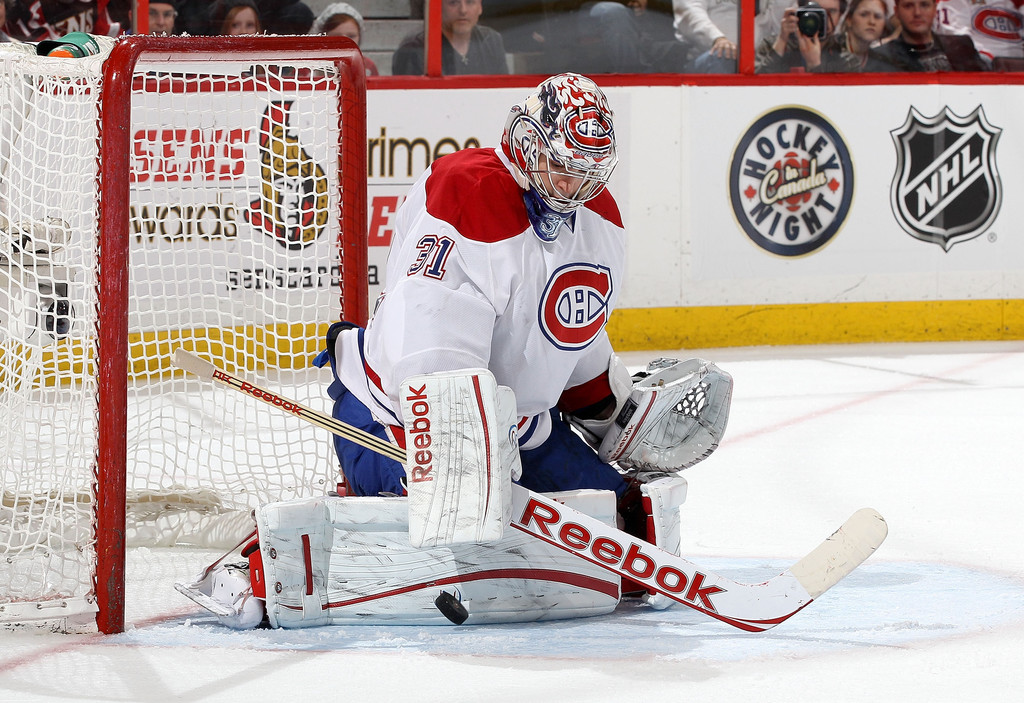
(Photo by Richard Wolowicz/Getty Images North America)

Sunday, August 26, 2012

Revisiting The NHL Rules Of Old: Goaltending

Beginning this Tuesday, the NHL will be digging through some video of hooking, holding and interference penalties that were administered last season.

The goal for Colin Campbell — Director of Hockey Operations — as well as some select general managers and coaches is to try and determine a standard on the implementation of interference penalties.

As the "think tank"— as Campbell calls it —gets set to tighten up ship, I thought I'd take a brief trip back to some interesting rules of old.

In considering our penalties and the tweaking of them, would we do well to take a page from the history books?

Goaltending

In regards to netminding, the very first change to the original rules was in the 1917-18 season. Originally, a penalty would be called on the goalie for dropping to the ice to make a save at any time. It wasn't until that season that they were permitted to do so.

Could you imagine? Carey Price would be giving Steve Ott a serious run for his money in the PIMs department.

Concern of a decrease in action and goal scoring goes as far back as the early twenties. One of the first examples of this was in 1921, where goalies were finally allowed to pass the puck up to a player, but only as far as his own blueline.

This may or may not have coincided with defense becoming the lazy man's first choice of position in beer leagues.

A more direct approach came with the first limit set for a goalie's pad width. Starting in the 1925-26 season, twelve inches was as thick as you could have them, and it was further reduced to ten inches in 1927.

The nineteen-thirties saw some familiar first incarnations of rules we see today, including penalties for doing the Sean Avery and obstructing a goalie's vision or movement.

What's more interesting though are the strange ones, which included things like the goaltender cannot advance more than one foot from his goal-line when a shot is taken (1934-35) or each team must have only one goaltender playing at one time (1931-32).

And rightly so! Imagine two Dominik Haseks flopping all over the place? It'd be absolute mayhem.

That's using the old noodle, fellas. The NHL: always a step ahead of everyone's tricks.

As for the 'one foot from the goal-line' rule, I'd like to imagine that goalkeepers were doing all kinds of outrageous things to stop attackers from even getting shots off in the first place.

Though I suspect it was mostly frequent rushing and challenging of the shooter that lead to the rule.

More chances, more breakaways, more shots, more goals, more fans, more money.

Perhaps the most interesting item I came across in regards to goalies was that they used to serve their own penalties. So, if Price delays the game, Peter Budaj gets thrown in nets for a penalty kill— this of course being when teams were eventually required to dress two goalies, which wasn't always the case.

How interesting would that make games, especially in the playoffs ?

As goalies were penalized a lot more often then, the back-up would see more action, and on a game-by-game basis.

Oh, but there's one tiny catch...

As a rule implemented in 1939 states, if you were the back-up, you were only allowed to use a goaltender's gloves and a stick. That's it.

Food for thought!

Next up, the Attackers and Rearguards portion of our trip back in time.
---
Amos is freelance writer and columnist who covers prospects for HabsAddict.com. You can follow him on Twitter and Facebook or email him at alegault@gmail.com

(Photo by Jana Chytilova/Freestyle Photo/Getty Images North America)

Monday, April 16, 2012

NHL By the Numbers: Playoff Fighting

Hello playoff fans,

I would assume that most of you have noticed that quite a few games in this years' playoffs have been very intense battles, to say the least.

People have been asking me if we really are seeing more fights than usual? Are penalty minutes on the rise? Or is this just your usual playoff "intensity"?

Think of it: when previously concussed superstars Sidney Crosby and Claude Giroux end up throwing blows at each other, there must some serious hatred going on.

"There's always more fighting in the playoffs."

Well, not quite. If you look at the below chart, which covers the last seven years of both regular season and playoff stats (all brought down to an 82 game average) you will notice that, on average, there are more than twice as many fights in the regular season (42 fighting majors per 82 games) as there are in playoffs (19 fighting majors per 82 games).

But what about this year?

Well, this year is a little different, indeed. Fighting majors are on the rise by 280% against the seven year average. This is only after 34 games (roughly 20% of usual 170-175 post season games), so things could change.


But game misconducts are also on the rise, by a whopping 450% over the same seven season average.

That's a clear indication that there have been quite a few more brawls than usual.

The 2011-12 regular season saw a decrease in minor penalties and total penalty minutes awarded for the seventh straight season. In fact, penalty minutes per game have been going down every year since the lockout.

The playoff numbers were pretty much following the same trend – until this year.

Is this the year the numbers go off the charts?


---
Frank Dumais is a freelance writer, currently contributing to HabsAddict.com “Habs By the numbers” weekly column. He writes on current Habs topics, but with a “numbers twist”.

Follow Frank on Twitter


(Photo by:Eric Hartline-US PRESSWIRE)